- Click Raven
- Posts
- Google Rewrites Headlines, OpenAI Kills Sora, and Jensen Says AGI Is Here
Google Rewrites Headlines, OpenAI Kills Sora, and Jensen Says AGI Is Here
Google tests AI headlines, rolls out a spam update, Sora gets shut down, and Nvidia redefines AGI in the most Nvidia way possible.

Ian Mutuli
March 25, 2026
Sponsored by

Hi there, welcome to this week’s updates from the AI marketing world. Just in case anyone thought the internet might settle down for five minutes:
Google is rewriting headlines, and rolling out another spam update
OpenAI has already killed off one of its flashiest products
Jensen Huang has declared AGI arrived right on schedule for Nvidia’s chip sales, and
apparently your About page now needs to introduce itself to both humans and machines.
In other words, the internet remains a calm, stable place where nothing weird is happening at all.
Before we dive in, we’re grateful to our sponsors below for helping keep this content free.
How Jennifer Aniston’s LolaVie brand grew sales 40% with CTV ads

The DTC beauty category is crowded. To break through, Jennifer Aniston’s brand LolaVie, worked with Roku Ads Manager to easily set up, test, and optimize CTV ad creatives. The campaign helped drive a big lift in sales and customer growth, helping LolaVie break through in the crowded beauty category.
How Marketers Are Scaling With AI in 2026

61% of marketers say this is the biggest marketing shift in decades.
Get the data and trends shaping growth in 2026 with this groundbreaking state of marketing report.
Inside you’ll discover:
Results from over 1,500 marketers centered around results, goals and priorities in the age of AI
Stand out content and growth trends in a world full of noise
How to scale with AI without losing humanity
Where to invest for the best return in 2026
Download your 2026 state of marketing report today.
Turn AI Into Your Income Stream

The AI economy is booming, and smart entrepreneurs are already profiting. Subscribe to Mindstream and get instant access to 200+ proven strategies to monetize AI tools like ChatGPT, Midjourney, and more. From content creation to automation services, discover actionable ways to build your AI-powered income. No coding required, just practical strategies that work.
Google is testing AI-written headlines in Search
Google has confirmed it’s running a small test where AI rewrites page titles in Search results, including for news sites. The goal is to better match headlines to search queries and improve engagement.
Why it matters: publishers are already battling lower click traffic, and now Google may also reshape how their stories are presented — sometimes changing tone, intent, and brand voice in the process.
Google says title links have always been automatically generated using page elements like title tags, headings, anchor text, and structured data. But this new test raises the stakes, especially for news publishers who rely on sharp, accurate headlines to win clicks and build trust.
The big concern: if AI changes meaning or strips away nuance, publishers could lose both traffic and credibility.
Google’s March 2026 Update Is Out
Google has rolled out the March 2026 spam update globally on March 24, and they say the rollout should wrap up within a few days.
This looks like a standard spam update, not a niche one, so if your rankings suddenly wobble this week, that may be why.
Sora lasted about as long as some people’s New Year’s resolutions.

OpenAI is shutting down its AI video app and ending its Disney tie-up, choosing to put its energy into bigger priorities like enterprise AI, agentic tools, and robotics instead.
ChatGPT image tools are staying, but the video party is officially over.
The funny part? Sora launched with massive hype, studio-quality clips, and all the “this changes everything” energy, only to get unplugged less than two years later.
Between heavy compute costs, copyright headaches, deepfake concerns, and brutal competition, OpenAI basically looked at Sora and said: great demo, but we have bills to pay.
AGI Is Apparently Here, And It Needs More Nvidia Chips
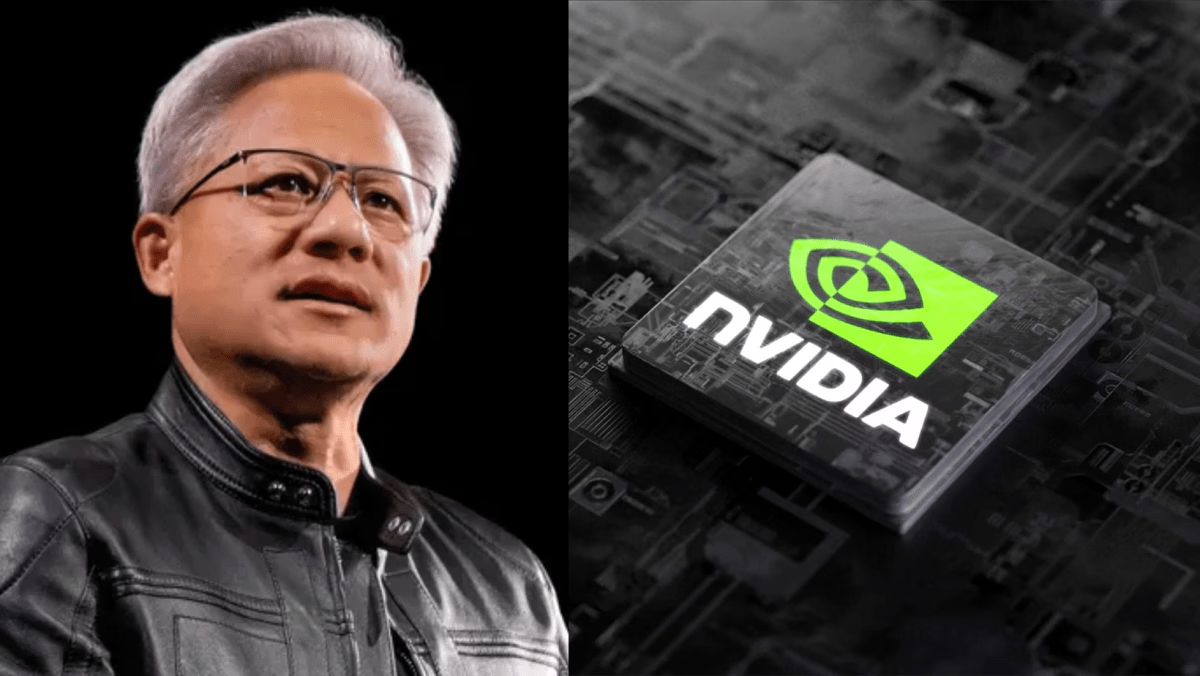
Jensen Huang, NVidia EO, just pulled off the corporate version of moving the goalposts and calling it innovation.
His take: if AI can spin up a billion-dollar app, find customers, and make money, then AGI is basically here. Not “write a novel and think like a human” AGI but more like “go viral, print cash, and maybe disappear a week later” AGI.
The convenient part? That definition also happens to make Nvidia’s chips look even more essential, because if AGI is already here, everyone suddenly needs more compute, more GPUs, and more Nvidia. How lucky.
Even Huang admitted AI still isn’t ready to build a company like Nvidia itself.
Bottomline: AI can apparently build a billion-dollar app, but not the company selling the shovels.
Your About Page Just Became Way More Important

Most brands treat the About page like a boring company bio. Big mistake. This piece argues it’s actually your entity home. It’s the page that helps search engines, AI systems, and real humans understand who you are, what you do, and whether you can be trusted.
The key idea: one page is not enough anymore. You need an entity home plus supporting pillar pages that reinforce your expertise, relationships, proof, and third-party validation. That’s how AI and search build confidence in your brand over time.
The bigger shift is this: websites are no longer built just for human visitors. They also need to educate algorithms and agents before a person ever clicks. In other words, your brand story needs to be well-designed, clear, structured, and corroborated.
AI content can get into Google fast but it usually can’t stay there on its own

In this 16-month test, 2,000 fully AI-written articles across 20 brand-new domains got indexed quickly and even picked up early impressions and clicks.
For a minute, it looked like scale alone might work.
Then reality arrived.
By month three to six, rankings collapsed, and only a tiny share of pages still sat in the top 100.
The pages stayed indexed, but mostly invisible.
Why? No backlinks, no authority, no real expertise, no strong internal linking, and nothing uniquely useful to separate them from the pile.
The most interesting twist: publishing fresh AI content later appeared to lift older pages temporarily.
So AI can help with momentum, but it’s not a substitute for SEO strategy, trust, and differentiation.
That’s it for today.
Later this week, we’re breaking down how one of the most popular companies today came to be. The growth moves, SEO plays, and strategic decisions that helped turn it into one of the most recognizable names today.
See you then.
Ian @ Click Raven