- Click Raven
- Posts
- Google’s AI Search Future, The March Core Update Fallout & Why Human Content Still Wins
Google’s AI Search Future, The March Core Update Fallout & Why Human Content Still Wins
Google’s core update is done, Search is becoming agentic, and new data says human-written content still dominates the top of SERPs.

Ian Mutuli
April 09, 2026
In partnership with

Hi and welcome to the Click Raven newsletter SEO insights this week.
Google finished its latest core update, reminded everyone that “helpful content” is still the answer to everything, then casually announced Search may soon become an AI task-doing butler that steals even more clicks.
Meanwhile, LinkedIn wants PDFs, Pinterest says repetition is boring, and fresh data suggests humans still outperform AI when it comes to ranking #1 on Google.
Let’s get into it.
Before we dive in, we’re grateful to our sponsors below for helping keep this content free.
AI agents now read your docs almost as much as humans do.

Mintlify analyzed 790 million requests across its documentation platform. The finding: AI coding agents account for 45.3% of all traffic, nearly tied with traditional browsers at 45.8%.
Two tools are driving almost all of it:
Claude Code: 25.2% of total traffic, more requests than Chrome on Windows
Cursor: 18% of total traffic
Together they account for 95.6% of all identified AI agent traffic
The rest of the field, OpenCode, Trae, ChatGPT, and NotebookLM, is showing up but nowhere close.
One caveat: OpenAI's Codex doesn't send an identifiable user-agent header, so the real agent percentage is likely even higher.
The takeaway for anyone maintaining developer docs: your documentation now serves two audiences. Structure and machine-readability matter as much as clarity for human readers.
How Marketers Are Scaling With AI in 2026

61% of marketers say this is the biggest marketing shift in decades.
Get the data and trends shaping growth in 2026 with this groundbreaking state of marketing report.
Inside you’ll discover:
Results from over 1,500 marketers centered around results, goals and priorities in the age of AI
Stand out content and growth trends in a world full of noise
How to scale with AI without losing humanity
Where to invest for the best return in 2026
Download your 2026 state of marketing report today.
Turn Google Ads into predictable customer acquisition

Echelonn manages over $15M/mo in Google and YouTube Ads for 300+ ecommerce brands. One vertical. One channel. Total focus. If you're not confident your account is performing the way it should, book a free audit.
The old “T-shaped marketer” model is no longer enough.

According to a new analysis, AI and automation have turned broad marketing competence into the baseline expectation — not the differentiator.
Today’s highest-paid PPC professionals are becoming “M-shaped”: experts with broad cross-functional knowledge plus 2–3 deep specialties such as attribution, automation, CRO, data engineering, or business strategy.

Why it matters:
Being good at one thing is increasingly risky when AI can automate or commoditize specialized tasks. The marketers commanding premium salaries are those who can bridge multiple disciplines and solve broader business problems — not just run campaigns.
The takeaway?
The new career moat is not deeper specialization in one lane. It is stacking complementary expertise across adjacent high-value domains.
In short: T-shaped is now the floor. M-shaped is where the premium lives.
Google says your website being “heavy” is not automatically an SEO problem, and SEOs may need to calm down a little.
In a recent discussion, Google explained that page size alone is a misleading metric because modern pages contain far more than visible content: images, scripts, structured data, metadata, compliance code, and machine-readable markup all add weight. A 15MB page is not “bad” if that weight serves a real purpose.
The real issue is not page size in isolation, but whether the weight is justified and efficient. Bloated junk is still bad. Useful complexity is not.
Translation:
Stop obsessing over raw page weight like it’s 2014. Optimize for efficiency, not anorexia.
Google’s March 2026 core update has finished rolling out …
after 12 days of ranking chaos, spreadsheet panic, and SEOs whispering “is it over?” every morning.
Now’s the time to check winners, losers, and which pages Google has lovingly thrown into the abyss. No new guidance: just make better content and pray.
Google says Search is no longer just trying to answer your questions, it wants to do the work for you.
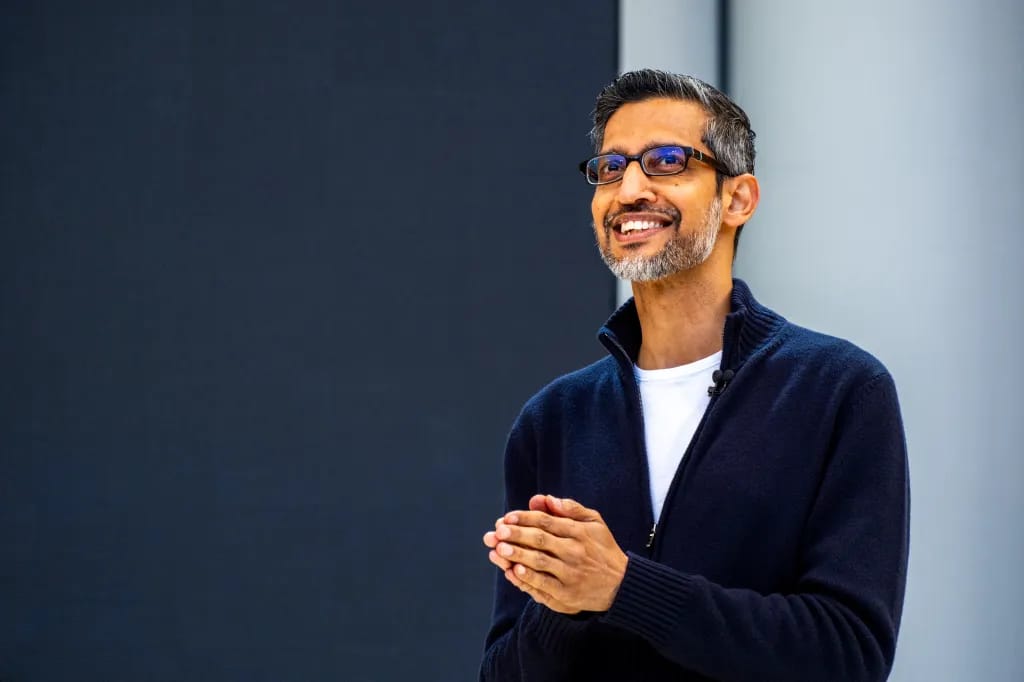
According to Sundar Pichai, Google Search is evolving into an “agent manager”: a system where AI handles multi-step tasks, coordinates tools, and helps users get things done instead of simply returning blue links.
In plain English: Google wants Search to become less “here are 10 websites” and more “sit back, I’ve got this.”
Why it matters:
This signals an even bigger shift away from traditional traffic-driving search toward task completion inside Google’s ecosystem. Informational queries may increasingly be handled without sending users elsewhere.
Google says Search and Gemini will coexist, but with overlapping roles.
The future of SEO may be less about ranking for answers… and more about being useful enough for Google’s robot intern to cite while it steals your clicks.
Listen to the full interview with Sundar Pichai here.
Pinterest says showing users more of the same is a short-term engagement trap.

New engineering insights reveal that overly repetitive Pins reduce session length and make users less likely to return. Instead, Pinterest now intentionally diversifies recommendations using broader signals like visual/text embeddings, co-engagement patterns, and behavioral similarity.
Why it matters:
Pinterest’s algorithm is optimizing not just for immediate clicks or saves, but for long-term engagement through content variety.
The platform now has 619 million monthly active users, and this recommendation strategy is part of what’s fueling that growth.
Lesson for marketers:
Repetition may convert today but diversity keeps audiences engaged tomorrow.
LinkedIn’s Surprise Winner: PDF Carousels Beat Video
New benchmark data from 1.3 million LinkedIn posts shows that document/carousel PDF posts generate the highest engagement on LinkedIn, outperforming even video.
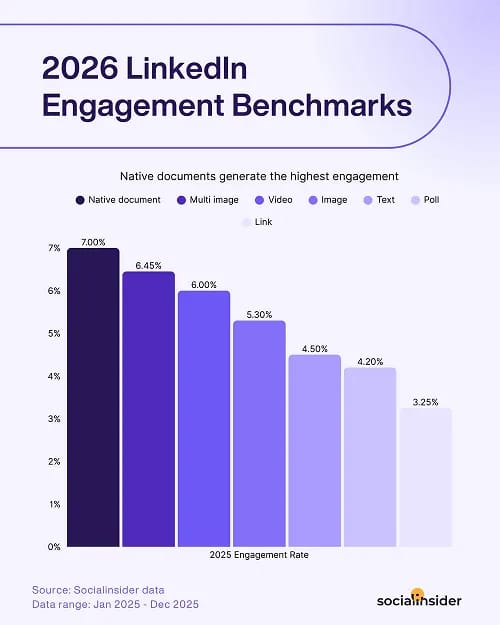
That’s unusual for social media, where video normally dominates.
Why it matters:
If you’re posting on LinkedIn, original research, frameworks, slide decks, and educational PDF carousels may outperform traditional video content.
The report also found multi-image posts earn the most likes, but document posts drive the strongest overall engagement.

Takeaway:
On LinkedIn, teach > entertain. PDFs are quietly becoming the platform’s engagement cheat code.
Human Content Still Wins Google’s Top Spot
A new Semrush study of 42,000 blog posts found human-written content dominates Google’s top rankings, with 80% of #1 results classified as human-written versus just 9% purely AI-generated.
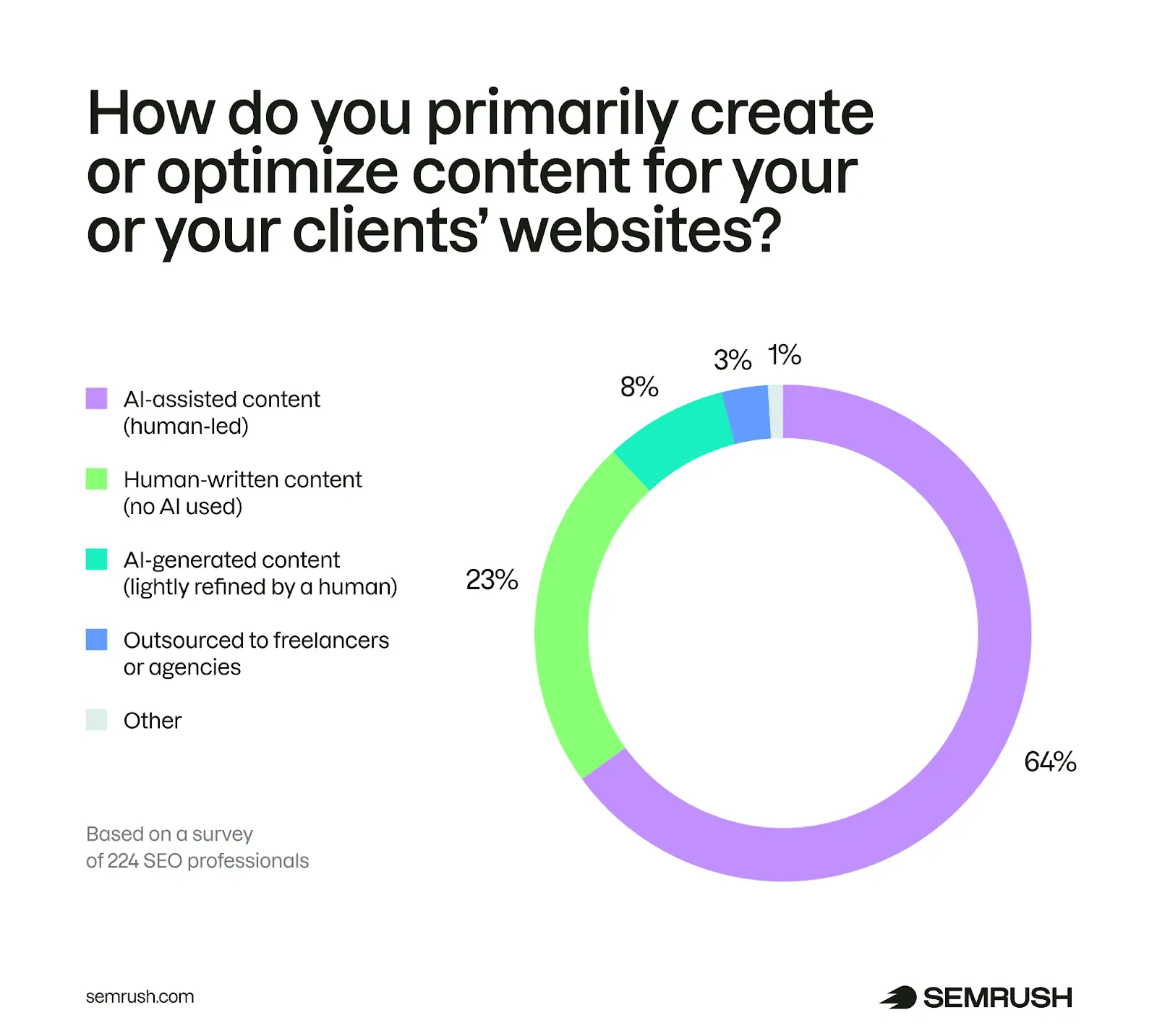
In fact, human content was 8x more likely to rank #1.
AI content still appears across Page 1 but more often in lower positions.
Why it matters:
AI can help you produce content faster, but the data suggests it still struggles to beat genuinely expert, original human-led content at the top of competitive SERPs.
Until next time,
Ian @ Click Raven