- Click Raven
- Posts
- The Quiet Signals Shaping Search in 2026
The Quiet Signals Shaping Search in 2026
Content decay, Google’s December core update, AI discovery, and where SEO is really heading.

Ian Mutuli
December 17, 2025
In partnership with

Hi there, welcome to the monthly Click Raven newsletter 👋 that wants to educate you about the latest insights in SEO and marketing.
In this issue, we’re covering three things that quietly shape search performance long before traffic drops or rankings move.
We look at:
how to identify content decay happening silently inside Google Search Console,
what Google’s December 2025 core update really means,
how AI agents are changing SEO workflows,
how LLMs can be used for research and insight without stripping away human judgment, and
why SEO in 2026 is less about rankings and more about visibility across AI systems.
Let’s get into it.
This newsletter reaches 23,000+ SEO and marketing leaders, with a ~50% open rate and ~500 new subscribers each month. This is issue #55 of 2025.
If you’d like to sponsor a future issue or be featured, just reply to this email.
How to Identify content decay on your website
One thing I keep seeing in Google Search Console is pages losing traffic quietly.
No alert.
No warning.
No “this page is decaying” notification.
The graph just flattens…
And weeks later you realize rankings slipped, CTR dropped, or intent shifted.
Content decay isn’t dramatic.
It’s silent.
Google Search Console shows averages.
Averages hide early decay.
Click Raven can show you your content decay before traffic disappears:
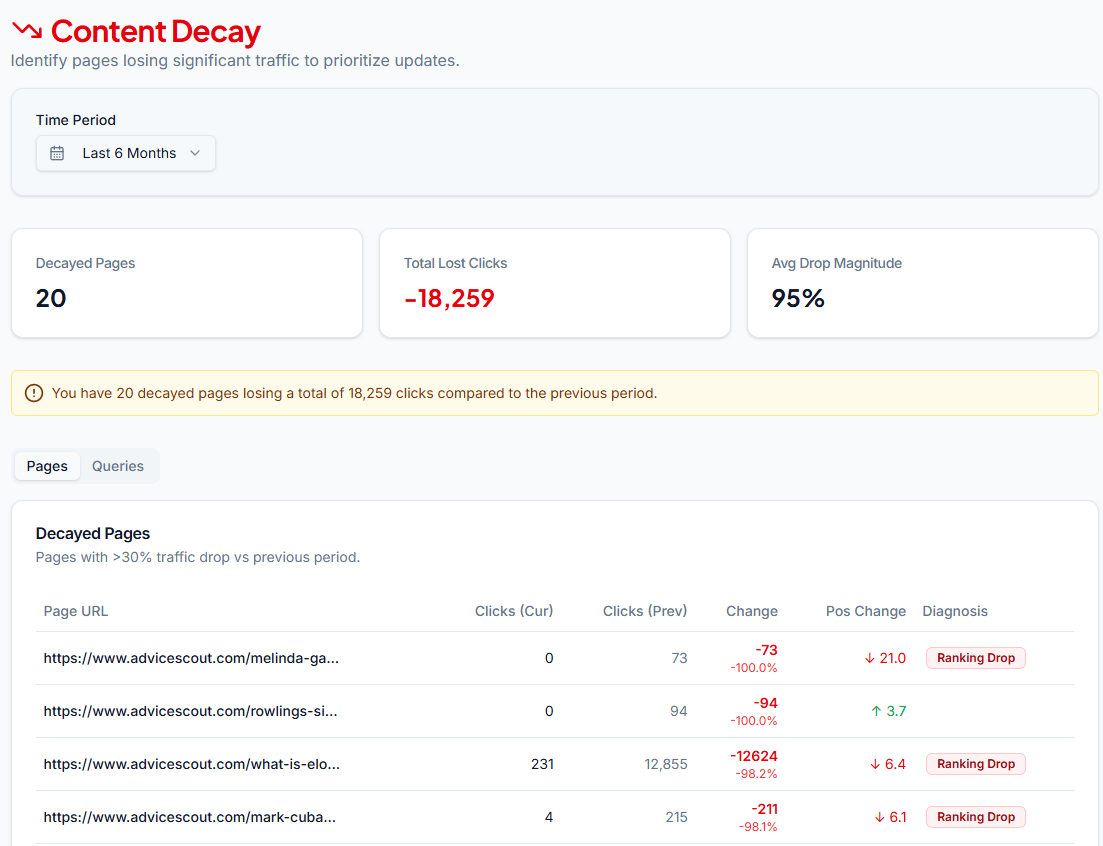
Pages losing momentum either due to CTR or rankings drop
Query-level drops hidden inside stable totals
Early signals that something changed
Google released the December 2025 core update
Google has begun rolling out its December 2025 core update.
As with previous core updates, this is a broad relevance update, not a penalty. Its goal is to better surface satisfying, high-quality content from all types of sites.
Expect ranking volatility during the rollout. Google will confirm completion on its ranking release history page once finished.
Reminder: Core updates reward alignment, not tricks. If visibility shifts, the fix is usually content quality, relevance, and intent matching — not technical tweaks. It’s best to let the update run its course, then give a settling time of 2-3 weeks, before you can assess and start to make hard changes.
The 5 things executives and SEOs must focus on in 2026

SEO isn’t dying.
It’s moving up the stack.
These are the three most important takeaways from Duane Forrester’s piece on the Search Engine Journal.
1. AI answer engines are the new front door
ChatGPT, Gemini, Perplexity, Copilot, and Apple Intelligence now sit between users and websites. Visibility depends on whether models choose you, not just whether Google ranks you.
Implication: You need visibility tracking beyond Google.
My take: AI visibility tools are still not worth the money yet. None of them simulate real prompts, and no AI platform is allowing scraping or provision of user data to show visibility analytics. I would be wary of any tools that say they can definitively help you with tracking for sure. Best to say, all the tools here are doing guesswork for now.
What’s the alternative? For now, track AI traffic using Google analytics. This is the only true metric even though it will not show you whether you were mentioned or cited but it will show you real traffic data from AI platforms.
2. Content must be built for machine retrieval
AI systems favor content that is structured, predictable, and easy to embed. Formatting, definitions, and consistency now influence whether content gets used in answers.
Implication: Information architecture becomes a ranking signal.
3. Zero-click environments are the real competition
Users increasingly get answers without visiting websites. Influence rises even as clicks fall.
Implication: Success shifts from traffic to being the preferred source inside AI answers.
Bottom line:
In 2026, you don’t optimize for one engine. You optimize for many AI-driven discovery layers at once.
👉 The article goes much deeper, including a major prediction about latent choice signals that will reshape how AI systems decide who to surface. Highly recommended reading it here.
Important reminder: Google still sends 156x more traffic to websites than AI platforms do, according to Ahrefs’ ChatGPT vs Google tracker. While you optimize for what could potentially be the future, Google will still be the King of Search in 2026, so keep this in perspective in your planning.
Shoppers are adding to cart for the holidays

Over the next year, Roku predicts that 100% of the streaming audience will see ads. For growth marketers in 2026, CTV will remain an important “safe space” as AI creates widespread disruption in the search and social channels. Plus, easier access to self-serve CTV ad buying tools and targeting options will lead to a surge in locally-targeted streaming campaigns.
Read our guide to find out why growth marketers should make sure CTV is part of their 2026 media mix.
Using LLMs to scale research without losing the human touch

Most teams use LLMs to produce content faster.
The smarter use is to make your content more human, grounded, and insight-led at scale.
Here are the 3 highest-leverage ways to do that.
1. Turn messy customer feedback into real insights
LLMs are exceptional at pattern detection across large datasets like NPS comments, surveys, and free-text feedback.
Best practice:
Keep raw data outside the LLM (BigQuery, CSVs, databases).
Use the LLM to write queries, not invent insights.
Feed query results back into the LLM for synthesis and visualization.
This reduces hallucinations and keeps insights anchored in reality.
Outcome: You spot trends, pain points, and language customers actually use without reading thousands of responses.
2. Capture SME knowledge without long interviews
Subject matter experts are time-poor, but their insights are gold.
Instead of hour-long calls:
Create a custom GPT that acts as a structured interviewer
Ask one question at a time
Let SMEs respond in 5–10 minutes between meetings
You can then use the LLM to extract themes, angles, or even first drafts.
Outcome: Deeper expertise in your content, with far less friction.
3. Analyze competitors at scale (strategically, not shallowly)
LLMs can synthesize competitive data far beyond basic “feature comparisons.”
High-value inputs include:
Reviews (to uncover benefits, complaints, gaps)
Website copy (positioning, audience, claims)
Historical messaging (via Wayback)
Job listings (future priorities)
Social engagement (unanswered questions)
Outcome: Clear differentiation based on evidence, not assumptions.
The big takeaway
LLMs work best when they augment research, not replace thinking.
Use them to:
Process large qualitative datasets
Surface patterns humans miss
Stay grounded in customers, experts, and the market
That’s how you scale insight without losing the human thread.
AI-native CRM

“When I first opened Attio, I instantly got the feeling this was the next generation of CRM.”
— Margaret Shen, Head of GTM at Modal
Attio is the AI-native CRM for modern teams. With automatic enrichment, call intelligence, AI agents, flexible workflows and more, Attio works for any business and only takes minutes to set up.
Join industry leaders like Granola, Taskrabbit, Flatfile and more.
Until next time.
Ian Mutuli, at Click Raven